John F. Kennedy, Barack Obama, and the Politics of Ethnic Incorporation and Avoidance by Robert C. Smith
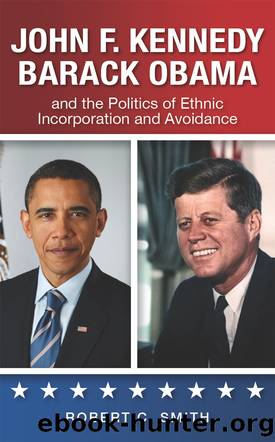
Author:Robert C. Smith [Smith, Robert C.]
Language: eng
Format: epub
Tags: Political Science, Political Process, Campaigns & Elections, History, United States, General, American Government, Executive Branch, Social Science, Ethnic Studies, African American Studies
ISBN: 9781438445595
Google: aqwTi4WM1MIC
Goodreads: 15945675
Publisher: SUNY Press
Published: 2013-03-01T00:00:00+00:00
Meanwhile, Kennedy described Thaddeus Stevens, the leader of the civil rights forces in the House, as âthe crippled fanatical personification of the extremes of the Radical Republican movement.â30
In the Senate Kennedy generally voted with the liberal civil rights bloc, although in 1957 he joined Majority Leader Lyndon Johnson and the southern segregationists in approving jury trials for persons accused of voting rights violations (making it virtually impossible to win convictions). But as he turned his attention toward 1960, he was haunted by the ghost of the 1948 election. When President Truman embraced the cause of civil rights in 1948, he split the Democratic coalition and nearly lost the election. Although Truman won a narrow, surprise victory, the defection of four southern states to the Dixiecrat party caused northern Democrats with presidential ambitions to downplay civil rights. Adlai Stevenson had pursued this course in 1952 (naming a southern segregationist as his running mate) and 1956, and Kennedy was determined to do the same in 1960.31 Thus, his principal concern about civil rights was strategic rather than principled. That is, he wanted to simultaneously maintain the support of blacks and southern racists.32 African American political and civil rights leaders clearly preferred Hubert Humphrey, the liberal Minnesota senator who had established his reputation in national politics by insisting that the Democratic Party adopt, for the first time, a civil rights plank in its 1948 platform. But Harlem Congressman Adam Clayton Powell (who had endorsed Eisenhower in 1956) went even further, declaring in effect that any candidate would be better than Kennedy.33 Meanwhile, Kennedy won the endorsement of the governors of Alabama and Mississippi, with the latter describing Kennedy as âDixie's favorite Yankee.â34 With Kennedy's agreement, the Democratic Party adopted the strongest plank on civil rights ever, but to placate the South he selected the South's favorite sonâLyndon Johnsonâas his running mate.
While working to balance the shaky coalition between the liberal and black civil rights forces and the conservative southern segregationists, Kennedy also had to pay attention to his own Catholic and Catholic Irish base. Many of the Catholic Irish leaders of the urban machines in the Northeast and Midwest were opposed to Kennedy's nomination because they did not think a Catholic could win. Haunted by the ghost of the Al Smith campaign, these leaders thought that another Catholic loss would be a setback to the cause of full political incorporation. The Catholic governors of California and Pennsylvania were skeptical about Kennedy's candidacy because it would ruin their chances for the vice presidential nomination. Finally, some were concerned that if elected, Kennedy would bend over backward to prove he was not pro-Catholic. By contrast, a Protestantâeven the Republican Richard Nixonâin order to appeal to Catholic voters would most likely be more sympathetic to Catholic interests and concerns. In a 1960 speech Sorensen said as much. Denying that Kennedy would be vulnerable to pressure from Catholics, Sorensen said, âIn fact, he would be less vulnerable to any possible pressure from the so-called Catholic vote than some non-Catholic politicians who might feel the need to cater to Catholics.
Download
This site does not store any files on its server. We only index and link to content provided by other sites. Please contact the content providers to delete copyright contents if any and email us, we'll remove relevant links or contents immediately.
| Anthropology | Archaeology |
| Philosophy | Politics & Government |
| Social Sciences | Sociology |
| Women's Studies |
Cecilia; Or, Memoirs of an Heiress — Volume 1 by Fanny Burney(32558)
The Great Music City by Andrea Baker(32019)
Cecilia; Or, Memoirs of an Heiress — Volume 2 by Fanny Burney(31956)
Cecilia; Or, Memoirs of an Heiress — Volume 3 by Fanny Burney(31942)
We're Going to Need More Wine by Gabrielle Union(19046)
All the Missing Girls by Megan Miranda(16029)
Pimp by Iceberg Slim(14508)
For the Love of Europe by Rick Steves(14121)
Bombshells: Glamour Girls of a Lifetime by Sullivan Steve(14076)
Talking to Strangers by Malcolm Gladwell(13370)
Norse Mythology by Gaiman Neil(13365)
Fifty Shades Freed by E L James(13241)
Mindhunter: Inside the FBI's Elite Serial Crime Unit by John E. Douglas & Mark Olshaker(9343)
Crazy Rich Asians by Kevin Kwan(9292)
The Lost Art of Listening by Michael P. Nichols(7506)
Enlightenment Now: The Case for Reason, Science, Humanism, and Progress by Steven Pinker(7314)
The Four Agreements by Don Miguel Ruiz(6765)
Bad Blood by John Carreyrou(6622)
Weapons of Math Destruction by Cathy O'Neil(6281)
